
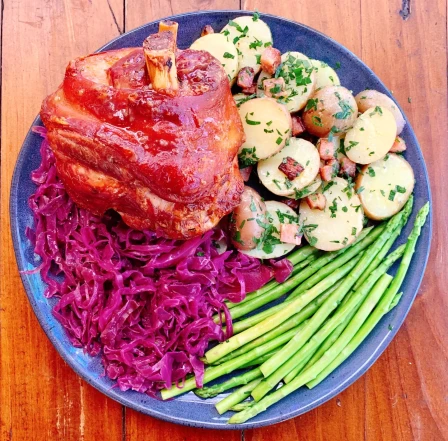
Pork knuckle, or schweinshaxe in German, is a beloved Bavarian specialty where a cured ham hock is roasted to perfection—crispy skin on the outside, tender and juicy meat inside. This dish is a prime example of how humble, inexpensive cuts of meat were transformed by clever cooking into hearty, satisfying meals for peasants in the region.
I opted to prepare roasted pork knuckle instead of eisbein, another traditional ham hock dish that is pickled and boiled. Though eisbein is sometimes hailed as a German national dish, its appearance in photos left me less inspired—so apologies to my German friends for this substitution!
Alongside the pork knuckle, I served German potato salad, or kartoffelsalat, which varies widely depending on the region. The southern style—favored by my southern German acquaintances—features red baby potatoes tossed with bacon, mustard, onions, vinegar, and fresh herbs. Northern German potato salad, on the other hand, tends to be heavier, swimming in mayonnaise regardless of the potato type. Clearly, the south takes the culinary crown here.
I also included steamed asparagus, a vegetable highly prized in Germany, especially the white variety during its season. It’s said that Germans consume about 1.5 kilograms of asparagus per person annually, a testament to its popularity.
To round out the meal, I served purple sauerkraut, a fermented cabbage dish famous worldwide but with a surprising origin story. Sauerkraut actually began in China, where cabbage was fermented with rice wine. It was introduced to Europe—possibly by the Tatars or even Genghis Khan—and adapted by adding salt instead of rice wine.
Sauerkraut became a staple across Europe, valued for its nutritional benefits. English explorer James Cook famously carried it on his voyages to prevent scurvy due to its enhanced nutrient bioavailability from fermentation. Although sauerkraut is now quintessentially German (to the point where “kraut” became a nickname, sometimes used derogatorily), its roots are truly global.
Making your own sauerkraut is surprisingly simple: chop cabbage, massage it with salt, and pack it into an airtight container submerged in its own juices—or water if needed. Leave it at room temperature, “burping” it daily to release gas buildup as lactobacilli on the cabbage naturally ferment the mixture. Don’t discard those outer cabbage leaves—they’re brimming with the bacteria that kickstart the process!
In Germany, sauerkraut is enjoyed warm or cold. Heating it too much, however, kills the beneficial gut bacteria essential for digestion and overall health, so I preferred mine cold. This fermented cabbage is reputed to soothe canker sores, support eye health, and may even inhibit cancer cell growth.
Store-bought sauerkraut, unfortunately, is usually pasteurized, losing many of these health benefits. So, for full advantage, homemade sauerkraut is the way to go—both delicious and packed with wellness magic.
This meal, with its blend of robust pork, tangy potato salad, tender asparagus, and vibrant sauerkraut, offers a rich taste of German culinary heritage—simple, hearty, and steeped in history.